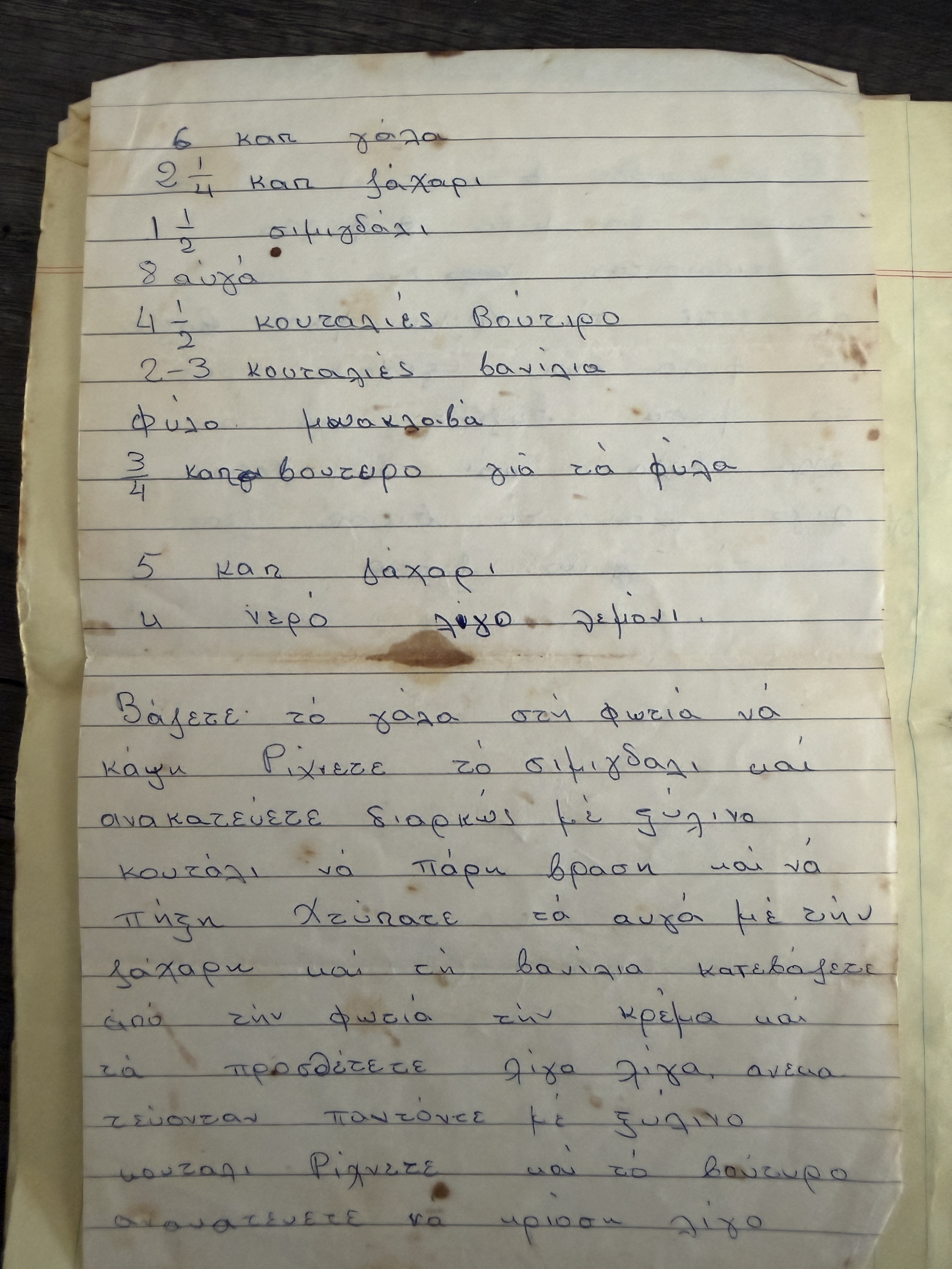
⚠ PARTIAL RECONSTRUCTION
The original recipe for this dish was written across multiple pages, but only the first is currently in our collection. The custard preparation is from the original; the assembly, baking, and syrup steps were reconstructed by AI from context and traditional methods. Please verify before cooking, and update this page when page 2 is found.
Ingredients
6 cups milk
2¼ cups sugar
1½ cups semolina
8 eggs
4½ tablespoons butter
2–3 packets vanilla
Phyllo sheets (baklava)
¾ cup butter for the phyllo
For the syrup:
5 cups sugar
4 cups water
A little lemon
Method
Put the milk on the heat to warm. Add the semolina and stir constantly with a wooden spoon; bring it to a boil and let it thicken. Beat the eggs with the sugar and vanilla. Remove the custard from the heat and add the egg mixture little by little, stirring constantly with a wooden spoon. Add the butter, stir, and let it cool slightly.
Reconstructed from here onward: Melt the ¾ cup of butter for the phyllo. Butter a deep baking pan and lay down half the phyllo sheets, brushing each sheet with melted butter as you go. Pour the custard evenly over the phyllo. Layer the remaining phyllo sheets on top, brushing each with butter. With a sharp knife, lightly score the top sheets into serving-size pieces.
Bake at 180°C / 350°F for about 45 minutes, until the top is golden and crisp.
While it bakes, prepare the syrup: combine the sugar, water, and lemon in a saucepan. Bring to a boil and simmer for 8–10 minutes until slightly thickened.
As soon as the galaktoboureko comes out of the oven, pour the warm syrup evenly over the hot pastry. Let it cool completely before cutting along the scored lines.
The original page ends mid-sentence at “stir and let it cool slightly.” Everything after that point — phyllo layering, baking time and temperature, and the full syrup method — was reconstructed from traditional Galaktoboureko methods.
Υλικά
6 φλιτζάνια γάλα
2¼ φλιτζάνια ζάχαρη
1½ φλιτζάνι σιμιγδάλι
8 αυγά
4½ κουταλιές της σούπας βούτυρο
2–3 φακελάκια βανίλιας
Φύλλο μπακλαβά
¾ φλιτζανιού βούτυρο για τα φύλλα
Για το σιρόπι:
5 φλιτζάνια ζάχαρη
4 φλιτζάνια νερό
Λίγο λεμόνι
Εκτέλεση
Βάλτε το γάλα στη φωτιά να ζεσταθεί. Ρίξτε το σιμιγδάλι και ανακατέψτε συνεχώς με ξύλινη κουτάλα, μέχρι να πάρει βράση και να δέσει. Χτυπήστε τα αυγά με τη ζάχαρη και τη βανίλια. Κατεβάστε την κρέμα από τη φωτιά και προσθέστε τα αυγά λίγο-λίγο, ανακατεύοντας συνεχώς με ξύλινη κουτάλα. Ρίξτε και το βούτυρο, ανακατέψτε, αφήστε να κρυώσει λίγο.
AI συμπλήρωση από εδώ: Λιώστε το ¾ φλιτζανιού βούτυρο. Βουτυρώστε ένα βαθύ ταψί και στρώστε τα μισά φύλλα, αλείφοντας κάθε φύλλο με λιωμένο βούτυρο. Ρίξτε την κρέμα ομοιόμορφα πάνω στα φύλλα. Καλύψτε με τα υπόλοιπα φύλλα, αλείφοντας πάλι με βούτυρο. Με κοφτερό μαχαίρι χαράξτε το επάνω σε μερίδες.
Ψήστε στους 180°C για περίπου 45 λεπτά, μέχρι να ροδίσει και να γίνει τραγανό.
Για το σιρόπι, βάλτε τη ζάχαρη, το νερό και το λεμόνι σε κατσαρόλα. Βράστε για 8–10 λεπτά μέχρι να πήξει ελαφρώς.
Μόλις βγει το γαλακτομπούρεκο από τον φούρνο, ρίξτε το χλιαρό σιρόπι πάνω στη ζεστή πίτα. Αφήστε το να κρυώσει τελείως πριν το κόψετε.
Υλικά (όπως γράφτηκε)
6 καπ γάλα
2¼ καπ ζάχαρη
1½ σιμιγδάλι
8 αυγά
4½ κουταλιές βούτυρο
2–3 κουταλιές βανίλια
φύλλο μπακλαβά
¾ καπ βούτυρο για τα φύλλα
Σιρόπι: 5 καπ ζάχαρη, 4 νερό, λίγο λεμόνι
Εκτέλεση
Βάζετε το γάλα στη φωτιά να κάψη. Ρίχνετε το σιμιγδάλι και ανακατεύετε διαρκώς με ξύλινο κουτάλι να πάρη βράση και να πήξη. Χτύπατε τα αυγά με την ζάχαρη και τη βανίλια. Κατεβάζετε από την φωτιά την κρέμα και τα προσθέτετε λίγο λίγο ανακατεύοντας πάντοτε με ξύλινο κουτάλι. Ρίχνετε και το βούτυρο, ανακατεύετε να κρυώσει λίγο…
[Η συνταγή συνεχίζεται στη 2η σελίδα — δεν είναι διαθέσιμη.]
Family Notes
Share a memory, a cooking tip, or a question about this recipe.
Loading notes…
Thank you — your note has been added.
The Original
2 pages · 1 located, 1 still missing · click a thumbnail to view
PAGE 1
⊘
NOT LOCATED
PAGE 2 · MISSING
Can you help?
If you have or know where to find the missing page, please get in touch.